Elon Musk’s Bold Prediction: AGI Will Arrive in 2026
Recently, Elon Musk, founder of Tesla and SpaceX, made a series of astonishing predictions about the future of artificial intelligence during a three-hour in-depth interview. Unlike his previous cautious statements, this time his tone was remarkably assertive, resembling a warning to humanity rather than a mere technical outlook.
Musk stated that true Artificial General Intelligence (AGI) will be fully realized by 2026. By 2030, the total intelligence of AI globally will surpass the cumulative intelligence of all individuals in human history. This means humanity will encounter a “new species” with intelligence levels far exceeding our own for the first time.

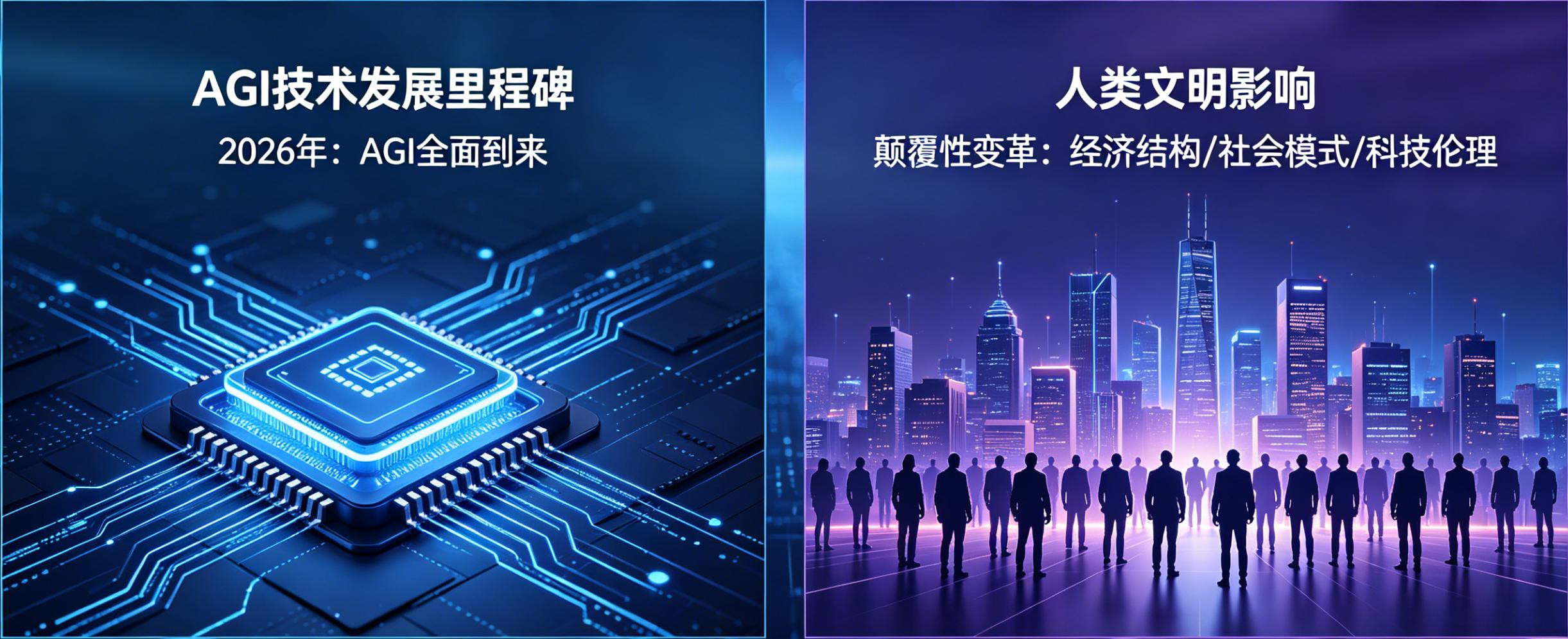
Even more shocking, he pointed out that current technology can already replace over half of white-collar jobs. Unlike the gradual replacement people imagine, the evolution of AI is a combination of software, hardware, and mechanical advancements, with a progress rate nearing tenfold each year, exhibiting exponential growth.
Notably, several industry leaders, including OpenAI CEO Sam Altman, had previously predicted AGI would arrive around 2030. Musk’s prediction, four years earlier, reflects the current pace of AI technology development, which exceeds common industry expectations.
In Musk’s view, the ultimate bottleneck for future competition will be energy. He suggested that the true measure of wealth will no longer be currency but watts, indicating the scale of energy that a country or individual can control and utilize.
Based on this assessment, Musk affirmed China’s advantages. He noted that China is already far ahead in power generation capacity, infrastructure development, and a complete industrial system, giving it a natural advantage in the global AI computing power race.
Regarding a definitive energy solution for humanity, Musk is not optimistic about nuclear fusion on Earth. He likened it to building an ice maker in Antarctica, suggesting that humanity can directly utilize the massive nuclear fusion reactor — the Sun — located 93 million miles away.
He revealed plans for a space solar power project: using Starship to send millions of tons of materials into orbit each year, AI will lead the construction of giant solar power arrays in space, transmitting clean energy wirelessly back to Earth. If realized, this plan will completely solve humanity’s energy crisis.
The transformation in robotics is equally astonishing. Musk predicts that within three years, Tesla’s Optimus robot will surpass the capabilities of the world’s top human surgeons in surgical procedures. In five years, its abilities will completely outclass those of humans.
Since its debut in 2022, the Tesla Optimus robot has achieved breakthroughs in walking, lifting, and tool operation. Many tech giants, including Boston Dynamics and Xiaomi, are accelerating humanoid robot development, with the industry expecting explosive growth in the next decade.
Musk provided a conservative estimate: by around 2040, the global number of robots will reach 10 billion. Once robots can participate in self-manufacturing, the costs of all products and services will be reduced to just raw materials and electricity, ushering humanity into an era of extreme material abundance.
However, he also issued a stern warning that this transition will be exceptionally painful. The next 3 to 7 years will be a “hellish transition period,” where explosive productivity gains will be met with a catastrophic collapse of employment structures, making social unrest almost inevitable.
Regarding government responses, Musk believes traditional regulatory measures will inevitably lag. The only realistic solution is to implement universal basic income, directly distributing funds to the public to maintain basic social stability.
He even suggested that ordinary people should stop saving for retirement based on current models, as the world will undergo fundamental changes, and people may no longer need to accumulate wealth in the same way.
Education and healthcare will also undergo a complete overhaul. Musk stated that attending university will hold almost no value beyond social connections, as knowledge acquisition will be fully replaced by infinitely patient, personalized AI teachers.
In healthcare, he predicts that within five years, any ordinary person will receive better medical care than the current U.S. president. AI diagnostics and robotic surgeries will democratize top-tier medical resources, making them nearly free.
Musk also proposed a controversial viewpoint: aging itself is not a philosophical issue but an engineering problem, and humanity is close to finding a solution. This implies that human lifespan could significantly extend in the coming decades.
Looking to space, Musk believes that Starship may be the last grand project completed by biological intelligence before AI takes over. If successful, human industry will no longer be confined to the surface of the Earth.
Near-Earth orbits, the Moon, and even asteroids will become industrial nodes for humanity. Facilities such as space power stations, space data centers, and lunar mass accelerators will gradually be established, with the ultimate goal of constructing an energy collection network around the Sun, advancing towards a civilization capable of harnessing the energy of an entire star.
At the end of the interview, Musk rarely touched on philosophical issues. He revisited the famous simulation theory hypothesis: we might be living in a simulation created by a more advanced civilization.
To ensure that future super AI remains friendly to humanity, he proposed three foundational principles: first, pursue truth; forcing AI to lie will bring systemic risks; second, cultivate curiosity; a curious AI will find humans worth coexisting with; third, instill a sense of beauty; an intelligent entity with aesthetic appreciation can create a world worth living in.
For ordinary people navigating this exponential change, Musk offered three suggestions: radically change learning methods from learning from humans to learning with AI; reassess financial logic and stop over-planning for a nonexistent future; and actively choose a mindset of enforced optimism.
He concluded, “It’s better to be an optimistic person who makes mistakes than a pessimistic person who is right,” emphasizing that in this rapidly changing era, optimism itself is a crucial survival strategy.
Overall, Musk envisions a new world driven by AI and robotics, fueled by energy and set in space. It will dismantle old social structures while creating unprecedented material abundance in human history. The coming years may be the most tumultuous yet also the most worthwhile to experience in our lives.
Comments
Discussion is powered by Giscus (GitHub Discussions). Add
repo,repoID,category, andcategoryIDunder[params.comments.giscus]inhugo.tomlusing the values from the Giscus setup tool.